Why does India have a flailing Healthcare System?
Premature imitation of programmatic recommendations from rich countries, mismatch between the ambition and newly independent poor states' ability, and the distrust of Samaaj and Bazaar continue to shape India's health system.
The Bhore Committee—the Health Survey and Development Committee—was established around 1943 and published its report in 1946. It was one of the first such committees to survey and understand the health of the Indian population comprehensively and to understand different health institutions that cater to the health needs of the population. It set short-term and long-term health policy goals. Its recommendations aimed to develop a robust healthcare system that would ensure everyone has access to preventive and curative modern medicine, irrespective of their ability to pay.
Three questions central to the Bhore Committee's recommendations, in the context of the poor health of the Indian population and new developments in health systems across the world, were:
"(1) Whether the service should be free or paid for by the recipient; if the latter, whether it should be a graded scale of payment so as to suit the level of the patient's income, and whether such payment should be made on each occasion when service is rendered or through some form of sickness insurance; (2) Whether the scheme should be based on a full-time salaried service of doctors or on private practitioners, resident in each local area or settled there on a subsidy basis; (3) Whether, in either case, some measure of choice can be given to the patient as regards his doctor."
Why are the 1946 recommendations of the Bhore Committee important to revisit in 2026?
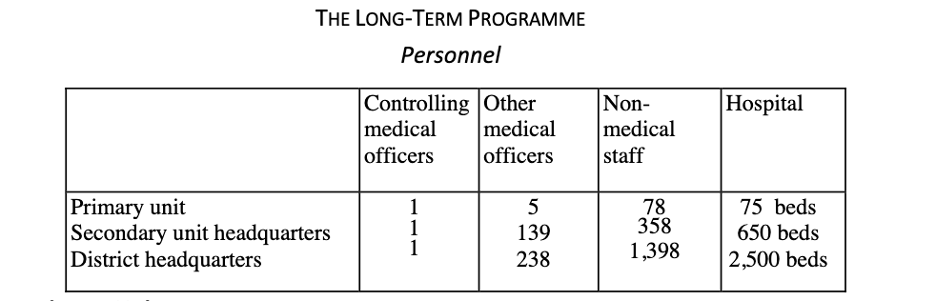
We see reflections of this policy design and thinking even today, e.g., Ayushman Bharat Pradhan Mantri Jan Arogya Yojana, especially the Ayushman Arogya Mandirs. The Bhore Committee recommendations set a tone for a three-tier health system with primary health units, sub-district units, and district healthcare units, requiring Medical Officers trained in modern medicine, with peculiarities like at least 2 Medical Officers at the primary unit being women and dedicated to maternal and child healthcare. There were to be public health nurses, a health assistant to relieve the workload of a Medical Officer, and non-medical staff. It proposed a decentralized process with a thin description of roles and outputs, but very few details on how these units could be funded and how the supply chain of the products required to run them could work.
Premature Imitation of policy goals from rich countries and isomorphic mimicry
Countries cited by the Bhore Committee as case studies were: social insurance powered by income tax, as in Australia and Canada; the USSR health system, powered by support from the government budget and social insurance through industry tax; the National Medical Services model of Great Britain, powered by compulsory income-based contributions and central and local taxation; and the cooperative medicine and insurance model of the United States. Around 1940, given the post-war realities, many of these countries reviewed their health systems. They expanded the scope of state intervention and support to deliver the modern healthcare their populations needed. None of the countries cited reflected comparable economic and state capacity realities of India!
The committee understood that the income of a very large proportion of individuals in India was so low that, for a person in India to access any sort of healthcare, it had to be free at the point of access. The committee also identified that any type of social insurance powered by income, local, central, or industry taxation would not be feasible. Yet, they put forth a very elaborate design for healthcare delivery, largely free at the point of access, delivered by mainly salaried professionals. This was to be achieved through infrastructure-intensive hospitals, trained medical officers, and non-medical support staff. All of it was to be powered by the central (union) and provincial (state government) budgets and accountability features. There was not much thought as to how the union and provincial governments would raise money for or from their union and state budgets, given the unchanged reality of very limited individual income, local, and industrial taxation capacity in India. This phenomenon of implementing policy goals and policy design from richer countries as it is, without matching policy ambition with existing state capacity, is called isomorphic mimicry.
Path Dependency
The Bhore Committee report presented noble ambitions, but there was a deep mismatch between these short-term/long-term goals and India's state capacity—financial, human resource, and governance capacity—to achieve them. As early as 1962, with the Muralidhar Committee report, the difficulty with the implementation of the Bhore Committee recommendations was identified. By then, the Bhore Committee report's goals and recommendations had set forth a self-reinforcing path dependency loop. Policy elites have had great difficulty prioritizing, deprioritizing, and matching the health system goals of comprehensive healthcare to the states implementation capacity.’
A policy that promises goals that are not rooted in the feasibility of its implementation strategy is often considered poorly designed/flawed policy. The Bhore Committee recommendations were fundamentally removed from the cost implications of its agenda and the trained human resources availability required to achieve its short-term and long-term goals.
Policy or a program?
Vijay Kelkar defines policy as ‘interventions by the government that reshape the incentives of private agents towards achieving desired social goals or objectives.’ By that definition, the recommendations of the Bhore Committee report are programmatic, not policy, in spirit. What does this mean?
The Bhore Committee report and recommendations identify the problems, look for "best practices" across the world, try to adapt these best practices for the Indian context, and present short-term and long-term outcomes. They do not map the activities and actions that need to be taken to make the outcomes a reality; they do not map the inputs and resources required to bring about the outcomes; and they definitely do not cross-check whether the designed outcomes match the resources that are available. The recommendations do not change the terms, conditions, and behaviour of stakeholders/private agents so that they can actively work towards ensuring that healthcare is delivered without any cost to the public. Lastly, these recommendations are not clearly delegated for them to be implemented properly.
Continuing this path dependency, the union and state governments predominantly view health policy in India through a 'do-it-yourself' programmatic lens—where, despite the lack of state capacity, an expansive list of health services is designed to be delivered end-to-end by the state. Policies through which the government marginally changes the incentives of the agents, or nudges and umpires the agents, are largely missing.
The Bhore Committee put forth programmatic recommendations for “state-dominated” health service delivery that were deeply skeptical of charitable institutions, NGOs, etc., and of the private sector, sentiment shared with leaders of newly Independent India. While analysing through the lens of involvement/engagement of Samaaj (society and individuals), Sarkar (state), and Bazaar (market), we see that the Bhore Committee's recommendations were distrustful toward the two other major forces in the policy system and barely addressed components like competition and capacity that can predict the success of any particular policy. This distrust is important to highlight because, by 1940, about 70% of trained medical practitioners operated in private and charitable institutions, mostly in urban centres. The Bhore Committee’s ambitious goals were aimed at improving the health of all Indians, but its recommendations were mainly focused on addressing weaknesses such as the absence of rural health infrastructure. The recommendations focused on developing a new model of health systems. They ignored and did not build on existing strengths, such as the role of charitable and private actors in urban healthcare. Therefore, the Bhore Committee’s recommendation did very little to alter the incentives of the majority of medical practitioners or the populations who already accessed care through these providers.
Continuing the legacy of the Bhore Committee recommendations, we see the following missing pieces in India's health policy:
a) There are mainly health programs and no health policies;
b) A designed health program is unable to reshape the incentives of agents, patients, and doctors; and
c) A designed health program is difficult to implement given the state capacity realities of newly independent India.
Failure of the three-tiered infrastructural decentralization
The tiered rural health system is unable to scale up, and existing urban health infrastructure is unable to develop further to deliver integrated care. The urban health infrastructure continues to deteriorate. Thereby, comprehensive healthcare needs of Indians remain unmet, and the top-down designed three-tiered health system is unable to train, recruit, and retain medical providers. To address this gap, we have seen formal and informal private actors step in and continue to expand the scope of modern-medical fragmented health services. For formal actors, this is given the baseline sustainable incentives, and that the people operating these private solutions choose to live and work in India rather than emigrate. For informal actors, this is because for the longest time there were not that many formal actors.
Premature imitation of programmatic recommendations from rich countries, mismatch between the ambition and newly independent poor states' ability, and the distrust of Samaaj and Bazaar embedded in the Committee's recommendation established institutional patterns and policy elite demand that continue to shape India's health system. This, in my opinion, helps explain persistent shortcomings in the design of the Indian Health System decades later.
-x-
PS: Note that the Bhore Committee report specifically has a chapter named financial implications of our program. It estimates non-recurring and recurring expenditure required. It has explaination that helps us understand that committee’s thought process
1) “We decided that our guiding principle should be that the short-term plan we advocate must be such as would produce, through its implementation, an appreciable improvement in the health of the people within the period of completion of the plan. This is a matter of even greater importance than questions of cost.”
2) “Though the expenditure involved will undoubtedly be many times that now incurred by Governments in the country, the responsibility which rests on the authorities concerned for finding the necessary funds is, in our view, inescapable, if a raising of the general level of health and prosperity among the people is to be secured and maintained.”
3) Goals for the Committee as described in its letter of appointment: “The letter of appointment of the Committee further stated, "A survey of the whole field of public health and medical relief has not hitherto been attempted. The immediate necessity for initiating such a survey has arisen from the fact that the time has come to make plans for post-war development in the health field (A Post-war Reconstruction Committee, that later grew into the Planning and Development Department was set up in 1943 to make 5 year Plans for India's development). The Government of India considers that such plans should be based on a comprehensive review of the health problem… One of the difficulties with which the committee will be confronted is that of finance. Financial considerations clearly cannot be ignored. Plans based on assumption that unlimited funds will be available for recurring expenditure will have little practical value. On the other hand it would be equally unwise to assume that expenditure on health administration will in the future be limited to the sums that were expended in the pre-war years. It is desirable, therefore, to plan boldly, avoiding on the one hand extravagant programmes which are obviously incapable of fulfillment and on the other hand halting and inadequate schemes which could have no effect on general health standards and which, would bring little return for the expenditure involved"
-x-
References and further readings
1) The Bhore Committee report Volume II: https://ruralindiaonline.org/en/library/resource/report-of-the-health-survey-and-development-committee-vol-ii/
2) https://thewire.in/health/why-indias-founders-championed-a-state-dominated-healthcare-system
3) Premature Imitation and India’s Flailing State: https://www.independent.org/pdf/tir/tir_24_2_01_rajagopalan.pdf
4) Reflections on the Art and Science of Policymaking: https://www.scribd.com/document/451791996/Final-speech-CD-Deshmukh-Lecture-2017-1
5) Bhore Committee (1946) and its relevance today: https://www.researchgate.net/publication/225747262_Bhore_Committee_1946_and_its_relevance_today
6) Lassance, Antonio, What Is a Policy and What Is a Government Program? A Simple Question With No Clear Answer, Until Now (November 10, 2020). Available at SSRN: https://ssrn.com/abstract=3727996 or http://dx.doi.org/10.2139/ssrn.3727996
*Credits to Ramana Krishnan for his valuable feedback on missing pieces and explanations in my article draft and for helping me edit this article.
*Disclaimer: If you notice any grammatical or factual inconsistencies, please do reach out. I appreciate your feedback.
*Parts that appear in double quotation marks and italics are reproduced directly from the original documents and reference materials listed in the reference section.
Disclosure of Delegation to Generative AI
The authors declare the use of generative AI in the research and writing process. According to the GAIDeT taxonomy (2026), the following tasks were delegated to GAI tools under full human supervision:
- Literature search and systematization
- Proofreading and editing
- Summarizing text
- Reformatting
The GAI tool used was: Claude, Grammarly, ChatGPT.
Responsibility for the final manuscript lies entirely with the authors.
GAI tools are not listed as authors and do not bear responsibility for the final outcomes.