Nurses and Nursing in Bihar
Key Reform Target: Bihar Nurses Registration Council (BNRC)
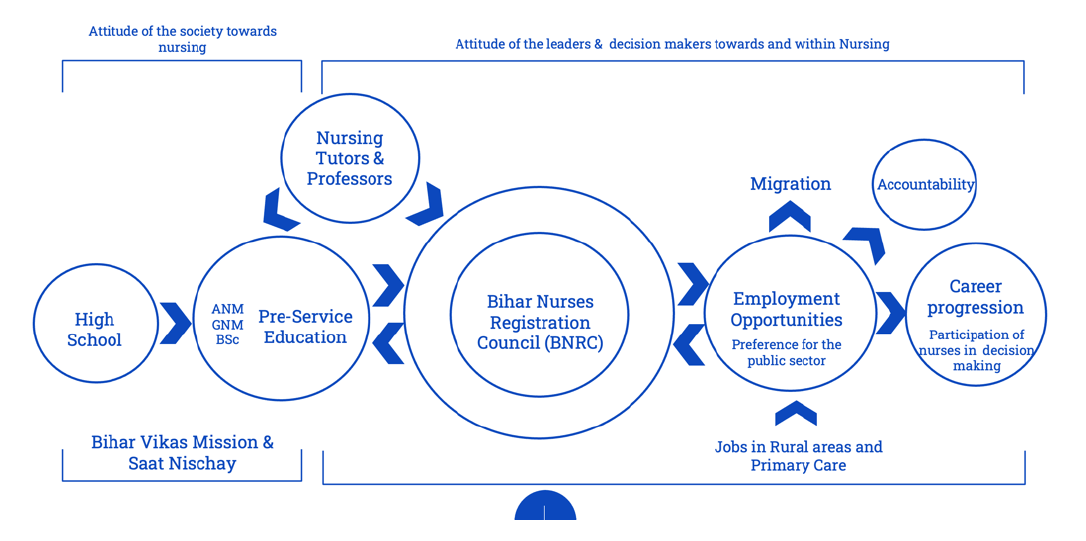
At the center of everything related to nursing in Bihar is the Bihar Nurses Registration Council (BNRC). I think BNRC is the starting point for nursing reforms from which all other changes must follow. Based on pre-existing literature (conducted mainly in March-April 2023) and key informant interviews (conducted December 2019- March 2020), BNRC is understood to be responsible for registering nurses, issuing licenses, conducting exams, and inspecting and certifying nursing institutions. All its actions are directed towards ensuring that candidates receive quality nursing education and that Bihar develops a capable nursing workforce.
However, BNRC still operates under the Act passed in 1935, which has never been revised. It functions out of an understaffed office and is managed by influential doctors who do not adequately understand the roles and functions of nurses and nursing.
Bihar also started nursing training courses quite late. Some programs, like the Master's degree, were introduced as recently as 2017. That said, there has been improvement in the number of people trained in nursing. Trained nurses have largely chosen to work in the public sector, driven by cultural preference, job availability, and public sector pay scales.
Reforming BNRC
BNRC is currently expected to perform many roles but lacks the human resources, policy frameworks, and institutional infrastructure (that is, the state capacity) to perform even a few of these roles well. This is evidenced by the fact that it is unable to utilise the funds it receives for these very purposes.
The two most important roles that BNRC should focus on, roles that no other body can perform, are: (1) conducting registration and issuing and maintaining licenses for nurses, and (2) maintaining the quality of nursing education.
On the registration and licensing front, BNRC has not been timely in registering trained nurses. This particularly affects nurses migrating from other states to Bihar. As a workaround, a court ruling now mandates that nursing licenses in Bihar be issued for lifetime, likely to avoid delays and costs associated with renewal. However, this is not effective in the long term, because it removes the mechanisms to address nursing malpractice and eliminates the opportunity to introduce incentive-based continuing education. These are two actions are critical to maintaining the quality and skills of the healthcare workforce after graduation.
On the quality of nursing education, the current approach to inspecting nursing colleges creates incentives for practices like ghost teachers, poor student attendance, and inadequate skill development. This is a significant problem because nursing is both a theory-intensive and skills-intensive profession. Inspections should be restructured to assess whether colleges are genuinely providing quality education, including English proficiency, digital literacy, and clinical problem identification and nursing intervention skills.
Over a ten-year horizon, BNRC should also work towards introducing continuing medical education, periodic license renewal every five to ten years tied to skilling and patient care updates, and a formal process for malpractice redressal. These changes will need to be legally formulated and passed. All of this will require legislative support, including the development of relevant guidelines, bylaws, and laws that enable these functions, culminating in an amendment of the BNRC Act of 1935.
Improving Information, Transparency, and Streamlining Admission Timelines
There are also significant problems related to admission timelines and the availability of accurate information. A separate government body, or at minimum a dedicated mechanism, should be established to streamline when nursing admissions take place and to make information on admission requirements, eligibility, and accreditation available in English, Hindi, and local languages.
Ideally, this function need not require direct government action; other actors can play this role. However, key informant interviews reveal a concerning pattern: new private nursing colleges offering only the ANM course have been employing third-party agencies to travel to villages and recruit students. These agencies have been misdirecting candidates who qualify for GNM or B.Sc. Nursing courses, which carry better career prospects, into enrolling in ANM instead. Other sectors, such as medical education, have streamlined timelines and centralised information sources that give aspirants access to credible information on admission timelines, prerequisites, and institutional accreditation. These are marginal interventions that can have long-lasting positive effects.
Conflict of Interest in BNRC's Role with Nursing Examinations
Finally, BNRC also conducts exams for nursing colleges. Nursing colleges appear to have the option of administering their exams either through BNRC or through a separate university. The role BNRC plays in conducting exams, when other options exist, creates a conflict of interest with its responsibility to assess and maintain the quality of nurses it is simultaneously registering and licensing. This dual role needs to be reviewed and separated.
Nursing Education and the Job Market for Nurses in Bihar: Recent Trends, Challenges, and Attitudes
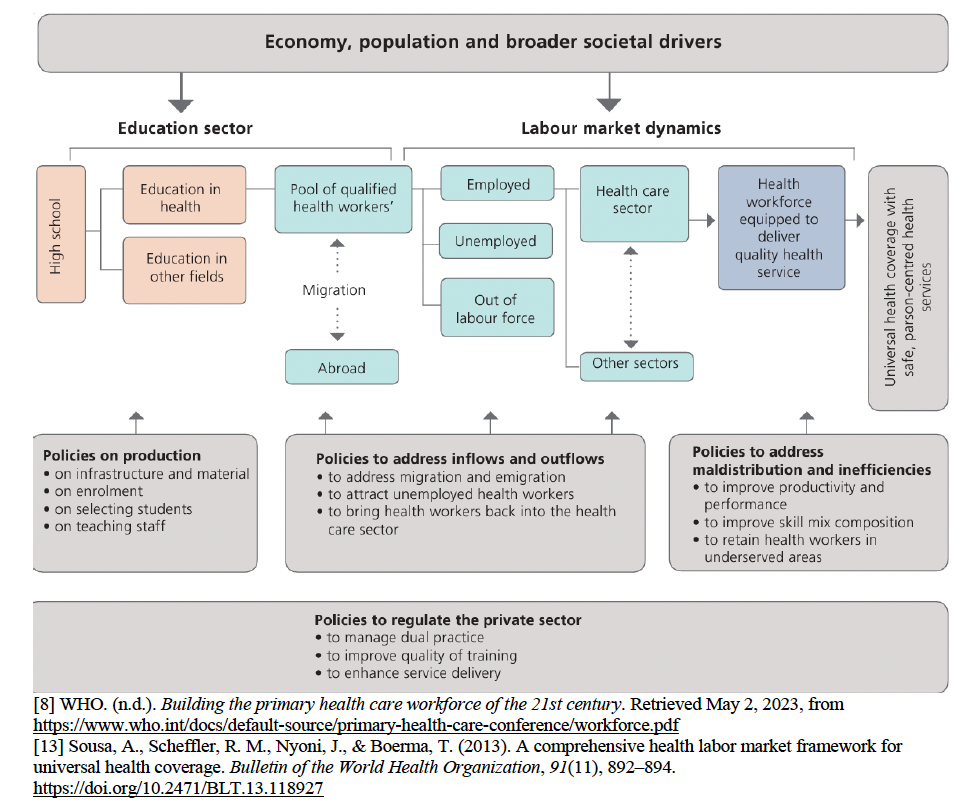
Problem: Shortage of nurses and concerns about the quality of nursing education, and thereby skilling. (Larger question about poor health outcomes in the state.) This summary write up focuses on investigating the labor market for nurses in Bihar and the sociocultural factors and policies that shape the market beyond simple supply and demand dynamics.
Context and Initiatives
- The Bihar Vikas Mission was launched in 2016 to improve nursing education in the state, with the main goal of establishing GNM and BSc Nursing programs in each district and ANM training programs in each sub-district. Programs such as Jhpiego and Care India's AMANAT Jyoti have also been working towards improving the quality of education and outcomes. Despite an increase in nursing programs in the public and private sectors, the shortage of nurses in Bihar continues. As of 2021, only 5,634 nurses were working in different health facilities, with 13,521 posts remaining vacant out of the 19,155 sanctioned posts.
- AMANAT Jyoti: A novel mentoring program for nurses, embedded within the government health system, was launched in the Indian state of Bihar in December 2017. The program aimed at improving the quality of deliveries at primary health centres.[1]
- "The overall delivery quality score was significantly higher by 5% in the mentored facilities (40%) than in the non-mentored facilities (35%; p-value 0.045). In particular, the domains of management in the second and third stages of labour and postpartum monitoring and counselling had significantly higher accomplished proportions in the mentored facilities. Overall, nurses at mentored facilities achieved less than half the quality actions required for high-quality care."[1]
Education
- Courses available include ANM, GNM (being phased out), and BSc Nursing, which differ in fees, English proficiency requirements, and prerequisite competencies in Physics, Chemistry, and Biology from high school.
- English proficiency is an important challenge. Very few colleges offer a one-month English boot camp at the beginning of the academic course.
- The MSc Nursing course, which helps develop nursing teachers and tutors, was launched in Bihar only in 2017-18. As a result, most teachers and tutors were migrants from other states, primarily from southern India.
- There is a strict age limit: enrolment and admissions close after the age of 35.
- The process for enrolment in nursing programs is fragmented, unlike in medicine or engineering. Different colleges have different entrance exams and admission timelines.
- This lack of coordinated processes means that while there is some flexibility in enrolment, the overall absence of transparent, timely, and credible information leaves potential students uninformed about the competencies required for different pre-service nursing courses.
- Private colleges employ third-party agencies to assist with enrolment when they face difficulties filling seats. These agencies visit remote villages and towns and provide information about courses offered by the contracted private college. However, they sometimes misinform eligible young women from local villages, encouraging them to enrol in ANM courses offered by these private institutions, even when they are also eligible for GNM or BSc courses elsewhere, which could have significantly different career outcomes and implications.
- Nursing college regulations and inspections result in issues like ghost faculty and the use of simulators in place of proper clinical training.
- There is a self-reinforcing cycle of poor teaching and poor attendance, compounded by the prevalence of coaching classes focused on preparation for government job exams. Nursing college becomes a means to obtain a degree certificate rather than an education.
Positive Observations
- There is a trend towards a more positive perception of nursing and an increase in its popularity, which can be attributed to the growing number of schools offering pre-service nursing education and the availability of jobs.
- "If we see nursing in Bihar, BSc Nursing has grown in popularity for the past five or six years. Around 2007, nobody knew about nursing in Bihar. It was considered a low profession. People have discovered that nurses care for patients' lives, which is a very noble profession. People have realised that nursing jobs are rarely affected by the recession. Now people are sending their kids to study nursing."
General
- There is a perception that nursing is a women-only profession. Some colleges did not accept male students because they did not have separate hostel facilities for men.
Labour Market
- WhatsApp groups play an important role in sharing information about existing vacancies.
- A significant portion of the ANM nursing workforce from Bihar is employed through the National Rural Health Mission (NRHM), usually on a contract basis.
- There are significant delays between job application, acceptance, and receipt of an appointment letter.
- The difference in pay between the private and public sectors is approximately 50%, with the public sector paying more.
- Government or public sector employment is the most popular option. However, vacancies are typically only open during election periods, when an incoming government uses appointments as a political strategy to demonstrate progress on employment and to gain support from different caste groups.
- After graduation, nurses prefer to work in central, state, or district hospitals. They are hesitant or unhappy about postings to sub-district facilities and PHCs, largely due to a lack of resources and infrastructure. Safety is also a concern, particularly when a nurse is the only staff member at a PHC without security guards or doctors available for night duty. Nurses are also reluctant to work in rural areas due to the lack of safe accommodation and basic amenities such as proper road lighting.
- Due to the English language barrier and the relative ease of accessing government job interviews, nurse migration from Bihar is not as high as in other parts of India. Nurses with a BSc degree are more likely to migrate than those with a GNM degree. ANM nurses are not qualified to migrate internationally. Those who do migrate to other states from Bihar are mostly students seeking further nursing education.
- There are limited career advancement opportunities, particularly in leadership and teaching positions. Unlike in other countries, pursuing postgraduate education does not necessarily result in financial benefits that outweigh the returns of continuing in a job obtained immediately after pre-service education. Few pathways for career progression exist unless an individual has several years of experience in a particular setting. Nurses working after their BSc or MSc who wish to pursue further education, such as an MSc or PhD, are required to obtain a No Objection Certificate from their employer. This creates a barrier for motivated individuals who want to pursue higher education in order to move into teaching or leadership roles.
Read full paper: Here
Further reading recommendation: https://pmc.ncbi.nlm.nih.gov/articles/PMC8121323/
Reference: [1] https://publichealth.jhu.edu/sites/default/files/2022-02/katahira-masahiro.pdf